

Insights to the tastiest bits…
Which Capital Cities Have Delivered the Best Long-Term Growth?
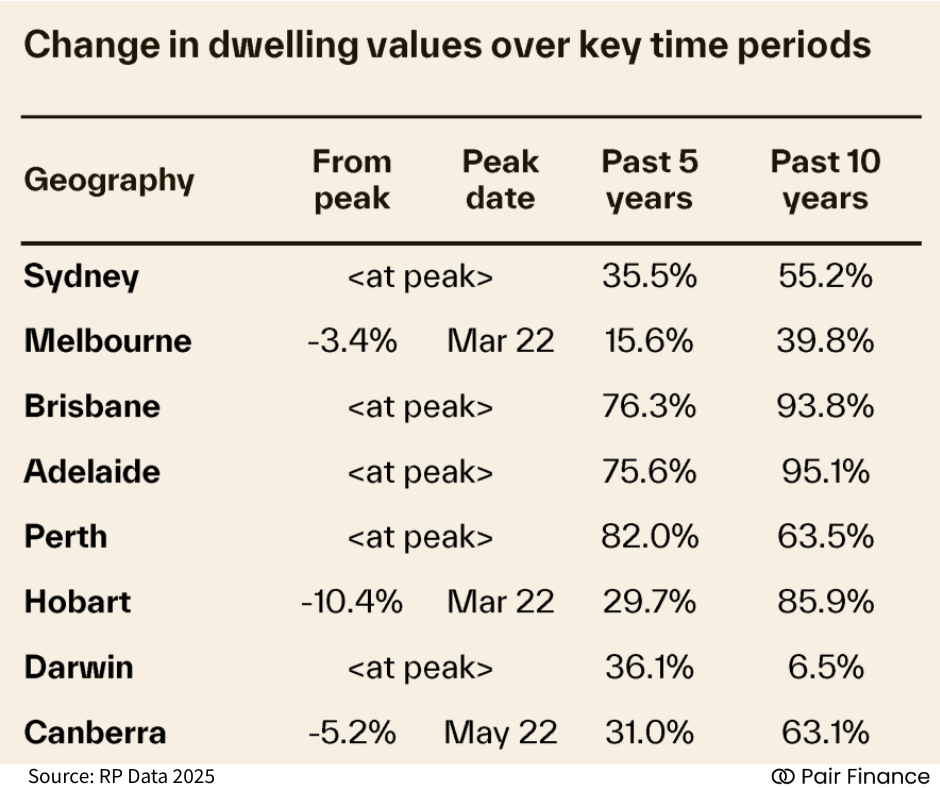
While Sydney and Melbourne have historically led property booms, their returns over the past 5 and 10 years now trail behind several smaller capitals.
Adelaide and Brisbane emerge as the standout performers. Over the past 5 years, both have seen values rise over 75%, and over 10 years they’ve delivered remarkable total growth of 95.1% and 93.8%, respectively. These markets have shown consistent, long-term strength and resilience.
Perth has delivered the strongest 5-year growth (82%), but over 10 years its return (63.5%) lags behind Adelaide, Brisbane, and even Hobart. Investors may find its recent momentum attractive, but the long-term picture is more modest.
Hobart saw a surge earlier in the decade, with 85.9% growth over 10 years, but recent performance has slowed (29.7% in 5 years), suggesting it may have already passed its peak cycle and could be in a consolidation phase.
Sydney and Melbourne, despite their size and stability, now sit mid-pack for long-term returns. Sydney’s 5- and 10-year growth stands at 35.5% and 55.2%, while Melbourne trails further at 15.6% and 39.8%.
Darwin and Canberra offer mixed signals. Darwin is at its peak and delivered a solid 36.1% 5-year return, but its 10-year growth is just 6.5%, the lowest of all capitals. Canberra, meanwhile, shows more balanced returns with 31% over 5 years and 63.1% over 10.
Insights
If you’re looking for both recent momentum and solid long-term performance, Adelaide and Brisbane remain the top contenders. They’ve not only grown fast - they’ve stayed strong across a full market cycle.
August 2025
House Prices Rise Across All Capitals – Year Ending July 2025
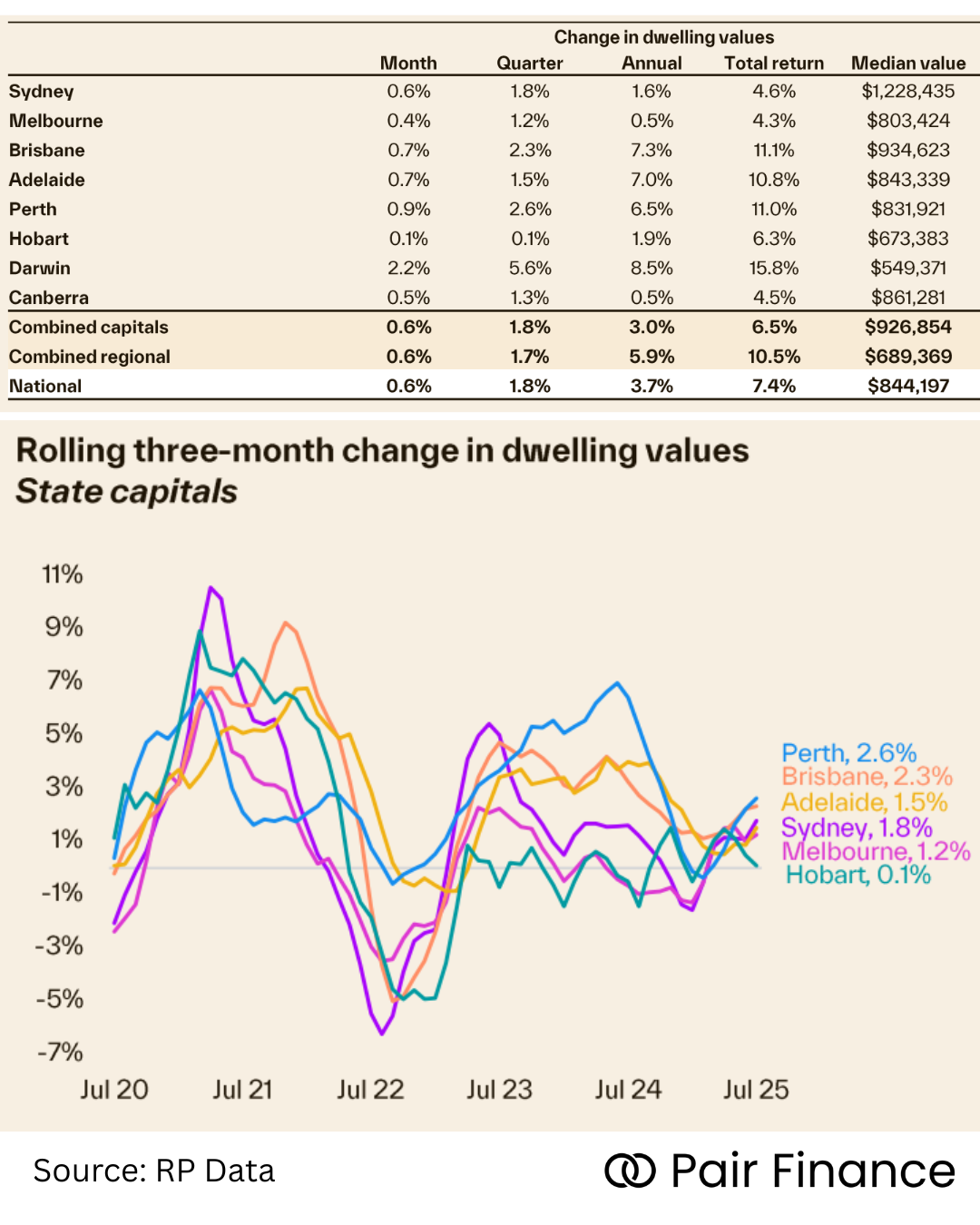
Sydney’s property market remains steady but subdued, with dwelling values rising 0.6% over the past month and 1.6% over the year. Despite the modest growth, Sydney retains the highest median value in the country at $1,228,435, reflecting its status as a premium market. In contrast, cities like Darwin, Brisbane, Adelaide, and Perth have seen stronger momentum. Darwin led the growth with an 8.5% annual increase and a 15.8% total return, even though it has the lowest median value at $549,371. Brisbane and Adelaide followed closely with annual gains above 7% and strong total returns above 10%. Meanwhile, Melbourne, Hobart, and Canberra have remained relatively flat, with annual growth rates between 0.5% and 1.9%.
August 2025
Brisbane cracks the million-dollar club
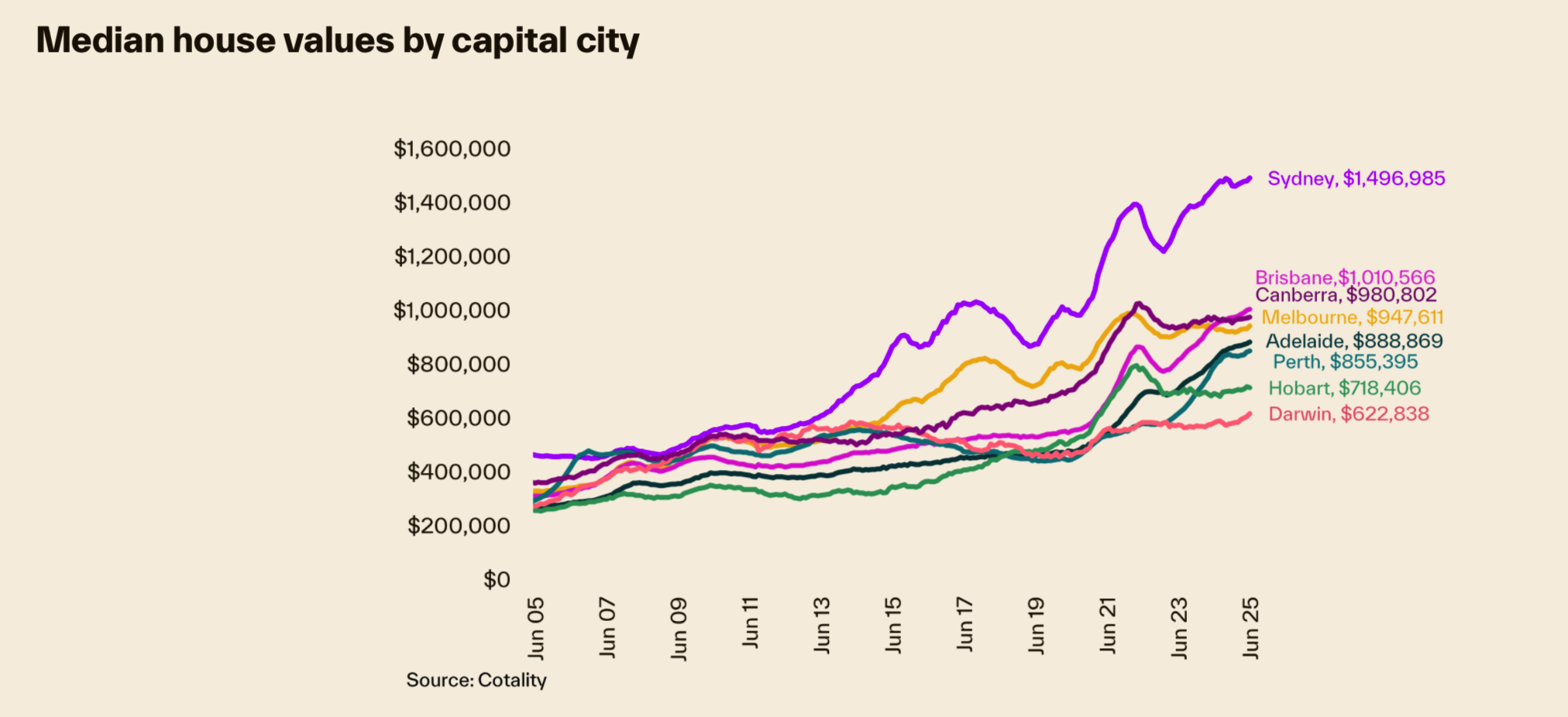
Brisbane cracks the million-dollar club, officially becoming Australia’s second most expensive capital city for houses, with the median price hitting $1.011 million in Jun — just behind Sydney’s $1.497 million. This milestone has been years in the making, driven by strong demand, limited housing supply, and record levels of interstate migration.
🔑 For investors, Brisbane presents compelling fundamentals:
9.2% population growth since 2020 (well above the national average of 6%).
Housing supply not keeping up with demand (88,000 built vs 94,000)
Low vacancy rates and high rental demand
Migration and job growth
July 2025
Australia’s housing market is heating up
Sydney’s auction clearance rate jumped to 72% at the end of May, up from 62% the previous week. Clearance rates fluctuate week to week, but anything above 70% usually signals a strong seller’s market — and rising prices. Similar trends are playing out in other major cities too, especially Melbourne and Adelaide.
We’ve now seen two rate cuts by the RBA this year — one in February and another in May — bringing the cash rate down to 3.85%. With recent economic data coming in soft, markets are almost certain another cut is coming in July.
🎯 Thinking of buying? It might be time to act.
🛠 Thinking of selling? July might be the time to prep.
📌 Now’s a great time to explore your options — whether you’re buying, selling, or investing.
June 2025

Inflation at Its Lowest at 4.3%: Impact on Mortgage Rates
January 2024
Good news! Australian inflation has come down from its peak from 8.4% a year ago to 4.3% as reported by the Australian Bureau of Statistics. But it remains above the RBA’s inflation target of 2–3%.
Despite these inflationary challenges, positive factors like strong population growth, private and public investments, and a substantial pipeline of projects are expected to bolster economic growth.
Many households are grappling with financial pressures stemming from elevated inflation and mortgage interest rates.
The Australian Financial Review survey indicates 31 out of 40 economists don’t expect the RBA to raise the cash rate in February. This is in contrast to a previous survey where 21 out of 42 economists predicted a rate rise in November, which did indeed occur.
If the RBA believes that inflation is likely to decrease as forecasted, there may be more good news in store, as the RBA may be less aggressive with interest rate increases and may decide to hold rates steady instead.
Good news! Australian inflation has come down from its peak from 8.4% a year ago to 4.3% as reported by the Australian Bureau of Statistics. But it remains above the RBA’s inflation target of 2–3%.
Despite these inflationary challenges, positive factors like strong population growth, private and public investments, and a substantial pipeline of projects are expected to bolster economic growth.
Many households are grappling with financial pressures stemming from elevated inflation and mortgage interest rates.
The Australian Financial Review survey indicates 31 out of 40 economists don’t expect the RBA to raise the cash rate in February. This is in contrast to a previous survey where 21 out of 42 economists predicted a rate rise in November, which did indeed occur.
If the RBA believes that inflation is likely to decrease as forecasted, there may be more good news in store, as the RBA may be less aggressive with interest rate increases and may decide to hold rates steady instead.
January 2024